
Kids MMA Classes Near Me: A Parent’s Guide to Choosing Well
Last Updated: November 27, 2026
Quick Summary
Kids MMA classes near me should start beginners with stance, movement and mat etiquette before any contact happens. A typical first class includes a warm-up, footwork drills, a padded positional drill and a cool-down. Ask to read the school’s written contact policy before your child steps on the mat.
- Most schools group beginners into age bands of 5-7, 8-10 and 11-14.
- Ages 5-7 train with no live contact, using pads and positional games.
- Ask for a written cost breakdown covering tuition, registration, gear and belt tests.
- Check mat condition, coach-to-student ratio, sparring policy and first aid supplies.
- A program that lets beginners spar hard in week one is a red flag.
Table of Contents
- Kids MMA Classes Near Me for Beginners: What a First Class Actually Looks Like
- Kids MMA Training Age: Finding the Right Starting Point for Your Child
- Safety First: Contact Rules and Injury Prevention in Youth MMA
- Kids MMA Class Cost: What Parents Pay For and What to Ask
- Best Kids MMA Classes Near Me: How to Evaluate a Program Before You Enroll
- Book a Trial Class at American TKA Martial Arts
- Frequently Asked Questions
Kids MMA Classes Near Me for Beginners: What a First Class Actually Looks Like
Most parents picture chaos the first time they search for kids MMA classes near me: kids throwing each other around, someone getting hurt, a coach yelling. The reality is calmer and far more structured. Beginners typically spend their first session learning stance, movement and mat etiquette before any contact happens, and the kids martial arts programs are built around that progression.
A typical first class follows a predictable shape:
- A warm-up with jumping jacks, bear crawls and stretching
- Stance and footwork drills in front of a mirror
- A padded grappling drill, usually positional, not sparring
- A short conditioning block and a cool-down
- A quick values talk on respect or focus before dismissal
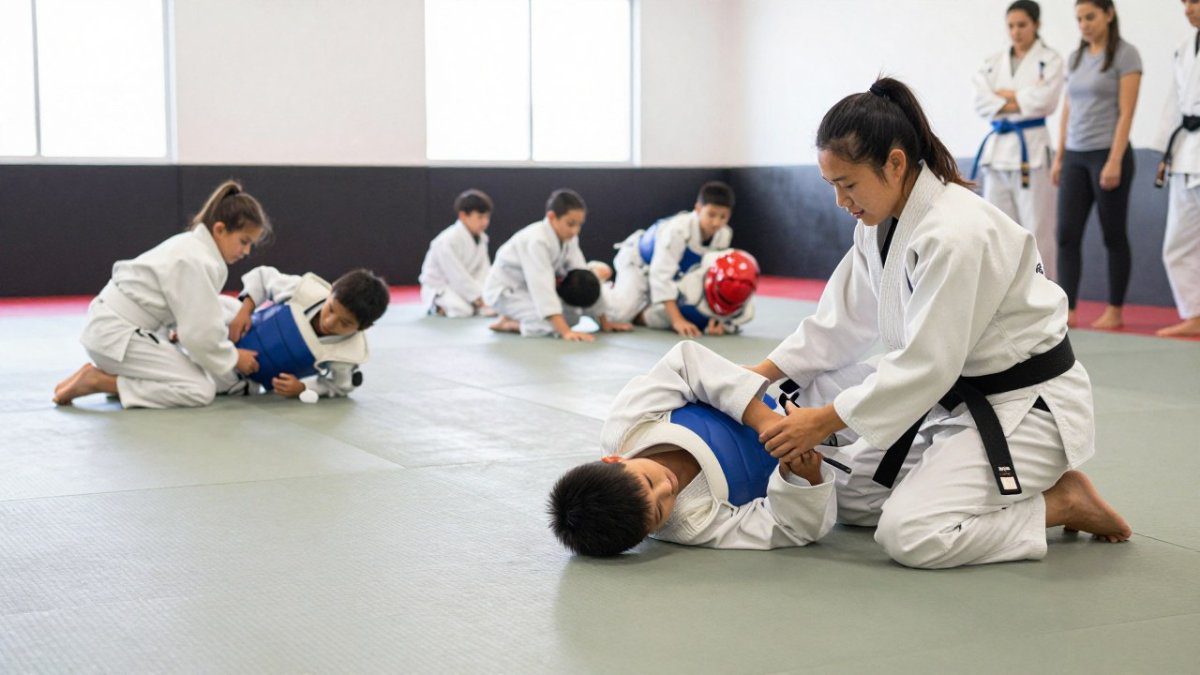
Kids are loud, but a good instructor keeps control of the room. Watch for that in any trial class you book.
Kids MMA Training Age: Finding the Right Starting Point for Your Child
The right kids MMA training age depends on the child, not just the birthday. Most academies group beginners by maturity as much as age, and a good rule of thumb is that a child who can follow two-step instructions and stay seated for a short talk is ready to try a class.
Age bands you’ll see at most schools:
- Ages 5-7: Movement games, basic strikes, no live contact
- Ages 8-10: Structured grappling and striking drills, controlled partner work
- Ages 11-14: More technical training, positional sparring with gear
A shy 7-year-old and a confident 7-year-old often need different placements. Ask the instructor where your child would land, and don’t be surprised if they suggest trying a class before deciding.
Most schools group beginners into age bands like these, though placement also depends on maturity.
| Age band | What training looks like |
|---|---|
| Ages 5-7 | Movement games, basic strikes, no live contact |
| Ages 8-10 | Structured grappling and striking drills, controlled partner work |
| Ages 11-14 | More technical training, positional sparring with gear |
Safety First: Contact Rules and Injury Prevention in Youth MMA
Safety in youth MMA is not a slogan, it is a set of written rules about who can make contact, where, and under what supervision. Reputable programs typically publish a contact policy, and you should ask to read it before your child steps on the mat.
Gear standards. For striking drills, programs commonly use mouthguards, padded gloves and shin guards. For grappling, a rash guard and shorts or a gi are typical.
Contact rules by age. A common pattern is:
- Ages 5-7: No live contact. Strikes are practiced on pads or in the air, and grappling is limited to positional games with a coach directing every rep.
- Ages 8-10: Controlled partner drills with gear. Positional grappling (guard, mount, escapes) is introduced, but live sparring is limited or absent.
- Ages 11-14: Technical sparring with gear, usually light contact and short rounds, with a coach supervising each pair. Head contact is often restricted until a student demonstrates control.
Supervision and ratios. Ask how many coaches are on the floor for a class of 15 or 20 kids. Smaller ratios generally mean closer correction and fewer collisions.
Injury prevention in practice. Beyond gear, look for a structured warm-up, a cool-down, and a rule that any student can stop a drill by tapping or saying “stop.” A stocked first aid kit, a coach trained in basic first response, and a written incident log are reasonable expectations to ask about.
What to check before your child steps on the mat:
- Mat condition: Clean, thick, and free of tears; ask when mats were last replaced.
- Coach-to-student ratio: Smaller groups generally mean closer supervision.
- Sparring policy: Beginners should drill, not fight; ask when live rounds begin.
- First aid: Ask what first aid supplies are on hand and whether staff are trained in basic response.
- Contact policy in writing: If the school cannot produce one, treat that as a warning sign.
Watch out: a program that lets beginners spar hard in week one, or that cannot explain its contact rules in plain language, is a red flag. Contact should scale with skill, and progress should be earned.
Kids MMA Class Cost: What Parents Pay For and What to Ask
Pricing for kids MMA classes varies by class frequency and program length, so ask for a written breakdown rather than a verbal quote. For current prices, contact American TKA Martial Arts directly.
The cost components to expect. A typical enrollment includes:
- Monthly tuition: The recurring fee for classes, usually billed monthly or per session pack.
- Registration or enrollment fee: A one-time charge to set up the account, often separate from tuition.
- Uniform and gear: A gi, rash guard, gloves, shin guards, and mouthguard may be included or billed separately. Ask whether gear is required at signup or can be purchased later.
- Belt tests or promotions: Some schools include testing in tuition; others bill a fee per promotion cycle.
- Competition or event fees: Optional, but ask whether tournaments, seminars, or belt ceremonies carry extra charges.
Contracts and cancellation. Ask whether the agreement is month-to-month or a fixed-term contract, and what the notice period is to pause or cancel. Get the cancellation policy in writing, a verbal “you can cancel anytime” is not enough.
Trial classes and intro offers. Many programs offer a trial class or an intro package. Ask what the trial includes, whether it counts toward enrollment, and whether you can watch the full class.
Questions to ask before you sign:
- What does the monthly fee include, and what costs extra?
- Is there a trial class or intro offer, and what does it cover?
- What is the cancellation or pause policy, in writing?
- Are belt tests or promotions included or billed separately?
- Is gear required at signup, and can it be purchased used or borrowed?
You can check our current class schedule to see how many sessions per week fit your family’s routine. Compare the total monthly outlay, tuition plus amortized gear and fees, not just the headline rate.
Watch out: a headline monthly rate that excludes uniform, registration or testing charges can cost more over a year than a higher all-inclusive rate. Ask for the all-in number before you compare programs.
Best Kids MMA Classes Near Me: How to Evaluate a Program Before You Enroll
Evaluating a program means looking past the brochure. Strong kids MMA classes generally share a few traits: instructors who explain the why behind each drill, a clear progression system, and a culture where older students help beginners.
Use this checklist when you visit:
- Instructors have verifiable rank and teaching experience
- The class has a warm-up, skill block and cool-down
- Students are grouped by age and ability
- Contact rules are posted or explained
- Parents can watch a full class
- Progress is tracked, not handed out
Read testimonials from our students and their parents to hear how families describe the experience, and meet our instructors to learn about their backgrounds before you commit. A quick conversation with a coach tells you more than any flyer.
Book a Trial Class at American TKA Martial Arts
The fastest way to judge a program is to stand in the room. American TKA Martial Arts offers martial arts training including Tae Kwon Do, MMA, Boxing and Brazilian Jiu Jitsu, led by black belt instructors, along with after-school care for working parents.
Start with a trial class. Watch how the coach talks to a nervous beginner, how the older students behave, and how your child feels walking out the door.
Talk to one of our martial arts instructors to ask about placement, scheduling and what to bring to a first session. Get started with American TKA Martial Arts and give your child a place to build real confidence.
Frequently Asked Questions
What age can kids start MMA training?
Most youth programs start around age 5 or 6, with classes grouped by age and skill level, often spanning ages 5-14. Younger children usually begin with fundamentals like coordination, stance, and basic grappling rather than full contact. Good programs place students according to age and readiness, so a 6-year-old and a 12-year-old train differently. Ask any program how they group ages before you enroll.
Are kids MMA classes safe for beginners?
Beginner classes should emphasize technique, control, and safety rules before any contact. Look for padded mats, protective gear, closely supervised partner work, and coaches who explain how they separate striking and grappling instruction by age. Ask about the program’s contact rules and injury protocol. A well-run kids MMA program treats safety as part of the curriculum, not an afterthought.
How much do kids MMA classes cost?
Cost varies by program, class frequency, and what is included, such as gear or after-school care. Pricing depends on the schedule and package you choose, so ask for a written breakdown of monthly fees, registration costs, and any equipment requirements. For current pricing and trial class details, contact American TKA Martial Arts directly before committing.
What should parents look for when choosing a kids MMA gym?
Check instructor credentials, age grouping, safety rules, class size, and whether a trial class is offered. Ask how progress is measured, since earned belt or skill advancement matters more than participation trophies. Visit during a class to see how coaches interact with students. A program that explains its contact rules, shows you the training space, and lets your child try a class before you pay is a stronger choice than one that pressures a quick sign-up.
