
Best Martial Arts for Adults: A Practical Guide to Choosing
Last Updated: November 26, 2026
Quick Summary
The best martial arts for adults depend on your goal, your body, and your schedule, since there is no single best style, only the best fit for you. Taekwondo, karate, boxing, and Brazilian Jiu-Jitsu all welcome complete beginners, and most adult programs start with fundamentals rather than sparring.
- An estimated 3.5 million U.S. adults practiced martial arts in 2022, about 1.4% of the adult population.
- Women make up roughly 30% to 40% of martial arts participants, up from about 20% a decade earlier.
- Pressure testing against a resisting opponent is the single most useful filter for judging self-defense value.
- Most adult beginners train two to three times per week for 60 to 90 minutes.
- Choose the school, not just the style, and use a trial class to evaluate instructor and culture.
Table of Contents
- Best Martial Arts for Adults: A Side-by-Side Comparison
- Martial Arts for Beginners Adults Can Start Without Experience
- The Best Martial Arts for Self Defense and What Each One Covers
- Martial Arts for Beginners at Home: What You Can Practice Before Joining a School
- Injury Risk, Recovery, and Adapting Training to Your Age and Mobility
- How to Choose a School and Instructor That Fit Your Goals
- Frequently Asked Questions
Best Martial Arts for Adults: A Side-by-Side Comparison
The best martial arts for adults depend on your goal, your body, and your schedule. An estimated 3.5 million U.S. adults practiced martial arts in 2022, about 1.4% of the adult population, according to Gitnux’s martial arts participation data.
The honest version most guides skip: there is no single best style, only the best fit for you.
How the Styles Stack Up on Fitness, Self-Defense, and Intensity
Each style emphasizes something different. The table below summarizes how the major options compare for adult beginners.
| Style | Fitness Focus | Self-Defense Focus | Intensity | Learning Curve |
|---|---|---|---|---|
| Taekwondo | Cardio, flexibility, balance | Striking at distance | Moderate to high | Beginner-friendly |
| Karate | Strength, coordination, discipline | Striking, blocks, situational awareness | Moderate | Beginner-friendly |
| Boxing | Cardio, footwork, conditioning | Punching, head movement | High | Moderate |
| Muay Thai | Full-body conditioning | Strikes from clinch range | High | Moderate |
| Brazilian Jiu-Jitsu | Strength, mobility, grip | Ground control and submissions | Moderate to high | Gradual |
| Krav Maga | Functional conditioning | Practical self-defense scenarios | High | Fast start |
| Tai Chi | Balance, flexibility, low impact | Limited | Low | Gentle |
Women make up roughly 30% to 40% of martial arts participants, up from about 20% a decade earlier, with growth concentrated in kickboxing, BJJ, and Krav Maga, according to Dojo Practice’s 2026 industry statistics. The mat is no longer a male-only space.
Martial Arts for Beginners Adults Can Start Without Experience
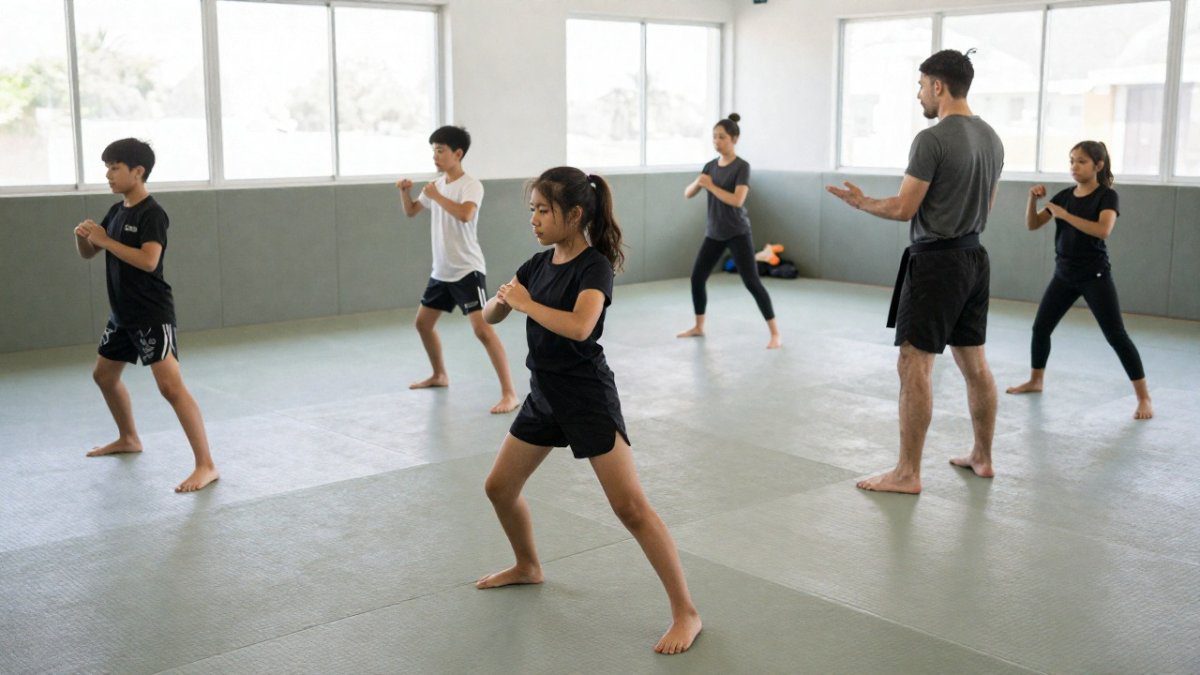
Taekwondo, karate, boxing, and Brazilian Jiu-Jitsu all welcome complete beginners. Most adult programs start with fundamentals, not sparring, and build up over weeks.
What the First Three Months Actually Look Like
Expect repetition, sore muscles, and small wins. Month one is stance, footwork, and basic strikes or positions; month two, chaining movements; by month three, most adults notice better balance, stamina, and coordination.
A common mistake is skipping warm-ups to “save energy.” That is exactly how adults pull hamstrings in week two. Warm up properly, every session.
To see how our adult and teen programs are structured, explore our adult and teen programs.
The Best Martial Arts for Self Defense and What Each One Covers
No single martial art is best for every self-defense situation, but the styles are not equally practical. Three variables decide it: whether the art trains against a resisting opponent, whether it covers the ranges a real confrontation passes through, and whether it teaches you to avoid the fight.
Training Realism: Pressure Testing Is the Dividing Line
A technique practiced only on a compliant partner is a theory, not a skill. Pressure testing, sparring, live drilling, or randori against someone trying to stop you, converts technique into usable reaction under stress. It is the single most useful filter for judging self-defense value.
- High pressure testing: Boxing, Muay Thai, Brazilian Jiu-Jitsu, wrestling, judo, and MMA-style programs. You regularly work against a resisting opponent, so timing, distance, and composure get tested.
- Moderate pressure testing: Karate and taekwondo programs vary widely. Some spar regularly under rules; others drill forms and one-steps with little live resistance. Ask how often adult students spar and under what rules.
- Low pressure testing: Tai chi and many weapons- or scenario-based programs. These build balance, mobility, and confidence, but do not simulate a real encounter.
Range Coverage: Where Each Art Leaves Gaps
A confrontation can start standing, close to clinch range, or end on the ground. Most arts specialize in one or two ranges and leave the others thin.
| Style | Striking (standing) | Clinch | Ground | Weapons / Awareness |
|---|---|---|---|---|
| Boxing | Strong (hands only) | Weak | None | Limited |
| Muay Thai | Strong (hands, feet, knees, elbows) | Strong | Weak | Limited |
| Karate | Moderate to strong | Weak | Weak | Varies by school |
| Taekwondo | Strong at kicking range | Weak | Weak | Limited |
| Brazilian Jiu-Jitsu | Weak | Moderate | Strong | Limited |
| Krav Maga | Moderate | Moderate | Moderate | Often included |
| MMA-style | Strong | Strong | Strong | Limited |
Read the table as a map of gaps, not a ranking. A boxer is dangerous at punching range but has no answer if the fight reaches the ground; a BJJ practitioner is dominant on the mat but may struggle absorbing strikes on the way in.
Situational Awareness Beats Any Single Technique
Good self-defense programs generally teach awareness explicitly: scanning exits, reading body language, de-escalating, and treating avoidance as a win. Ask whether awareness and de-escalation are part of the curriculum or an afterthought.
Watch out for a school that promises you will ‘never lose a fight’ or guarantees black belts in a fixed timeframe; real self-defense training includes getting humbled in sparring and learning from it.
A Practical Shortlist by Situation
- Most likely to face a standing confrontation: Boxing or Muay Thai for striking range, paired later with a grappling art.
- Most likely to be grabbed or taken down: Brazilian Jiu-Jitsu or judo for ground control and escapes.
- Want one program that touches all ranges: A reputable MMA-style or Krav Maga program with live drilling, but vet the school carefully.
The honest conclusion: the best self-defense art for you is taught at a school that pressure-tests its techniques, covers more than one range, and treats avoidance as the first line of defense.
Martial Arts for Beginners at Home: What You Can Practice Before Joining a School
You can build a real foundation at home before your first class. Focus on mobility, basic stance, and conditioning.
- Five minutes of joint mobility each morning
- Bodyweight squats and push-ups, three sets
- Shadowboxing for footwork and rhythm
What you cannot learn alone is contact, timing, and correction from an instructor. Home practice prepares your body; a school teaches you the art.
Injury Risk, Recovery, and Adapting Training to Your Age and Mobility
Injury risk in martial arts is real but manageable. Most adult injuries come from training past fatigue, skipping recovery, or returning too fast after a layoff.
Adapt training to your body, not the other way around. A review of youth martial arts research found personal-growth and self-acceptance scores were significantly higher among taekwondo practitioners than hockey practitioners, according to Vertonghen and Theeboom’s review via PubMed Central.
How to Choose a School and Instructor That Fit Your Goals
Choose the school, not just the style. A great instructor at a modest dojo beats a famous style taught badly, and the gap between a good and a poor school is larger than the gap between most styles. Here is a repeatable way to evaluate a school before you commit money or time.
The Trial-Class Checklist
Most reputable schools let you watch or try a class before signing anything. Treat that visit as an audition, of the school, not of you. Bring this checklist and score each item honestly.
- Instructor credentials: Who teaches the adult classes specifically, and what are their ranks, competition background, and teaching experience? A high rank does not automatically mean a good teacher.
- Beginner support: Is there a structured intro period, or are beginners thrown into advanced classes on day one? Ask how the first month is organized.
- Modifications: How does the instructor adapt drills for injuries, older students, or limited mobility? A good answer is specific, not ‘we scale everything.’
Red Flags to Walk Away From
Watch out: long-term contracts with large cancellation penalties, pressure to sign on the first visit, promises of a black belt in a fixed number of months, and instructors who cannot name a single modification for an old injury are all reasons to keep looking. A school confident in its product will let you try before you buy and will answer cost questions plainly.
What It Realistically Costs and How Much Time It Takes
Pricing varies by program and schedule, so ask the school directly for current rates rather than trusting online estimates. Adult tuition is commonly charged monthly, and equipment is often a separate one-time cost.
Time commitment matters as much as money. Most adult beginners train two to three times per week for 60 to 90 minutes, enough to see progress without overwhelming recovery.
Match the School to Your Goal
Use your primary goal to weight the checklist. If self-defense is the goal, prioritize pressure testing and range coverage. If fitness, prioritize class intensity and conditioning.
At American TKA Martial Arts, our instructors include Master Ginarte, a 4th Dan in Tae Kwon Do and 1st Dan in Shotokan, and Mr. You can meet our instructors and team, review our class schedule, read testimonials from students and parents, or talk to one of our instructors with your questions, and use the checklist above on any school you visit, including ours.
Choosing a martial art is a decision about consistency, not perfection. The style you will actually show up for twice a week beats the “optimal” one you quit in a month.
Frequently Asked Questions
Can adults start martial arts with no experience?
Yes. Most schools run beginner classes built for people who have never trained before. You do not need prior fitness, flexibility, or coordination. Adult beginners typically start with basic stances, footwork, and simple strikes or escapes, then add sparring and more complex techniques over weeks. The learning curve is real, but the first month is designed to be manageable. Visit a class and watch before you commit, and ask whether the school separates true beginners from students with prior training.
Which martial art is easiest for adults to start as beginners?
Taekwondo, karate, and boxing tend to have the gentlest on-ramp for adults because the first classes focus on stance, footwork, and single techniques you can drill alone. Brazilian jiu-jitsu has a steeper start because it involves close physical contact and ground positions, though many schools offer dedicated beginner programs. Muay Thai and MMA sit in the middle. The honest answer is that the instructor and class format matter more than the style for your first few months.
How often should an adult beginner train in martial arts?
Two sessions per week is the standard starting point. That gives you enough repetition to retain techniques while leaving recovery time, which matters more for adults than teenagers. Add a third session once your body adjusts, usually after four to six weeks. Adults training for self-defense often keep two classes plus one conditioning session. More than four hard sessions a week early on raises injury risk without speeding progress much.
What should adults look for in a martial arts school?
Check instructor credentials first: rank, competition or coaching history, and whether they can explain why a technique works, not just how to copy it. Ask about class sizes, beginner separation, sparring rules, and safety equipment. Watch a class before signing anything. Confirm the total monthly cost, contract length, and cancellation terms in writing. A good school will let you try a class and will answer questions about injury policy and student retention without pressure.
